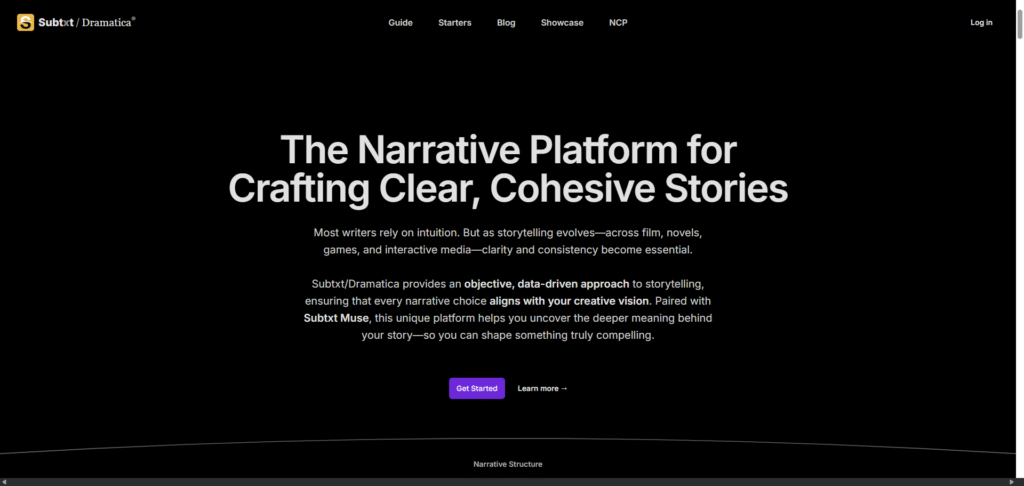
Subtxt (also referred to as Subtxt/Dramatica) is built for novelists, screenwriters, game writers and other long‐form storytellers who require more than simple text generation.
Rather than simply generating paragraphs, Subtxt supports you through the entire narrative process: from capturing your initial idea, mapping character arcs and throughlines, to refining scenes and threads for conflict and cohesion. It pairs AI generation with a structured model called the Narrative Context Protocol™ (NCP) and the Dramatica® framework to ensure that each element of your story aligns with your creative vision.
With features like Muse (its multi-agentic narrative assistant), NarrativeSync, DevelopAI and ReviewAI, Subtxt helps you brainstorm, structure, analyze and polish your story. It doesn’t just produce “nice prose” — it helps you build meaningful conflict, thematic depth and narrative logic.
Features
- Storyform & Narrative Structure Advisor
Subtxt helps you define your story’s overarching structure (throughlines, domains, objectives) so that all scenes, characters and arcs align.
- Muse – Multi-Agent Narrative Assistant
Muse acts as your AI writing partner, assisting you with generating ideas, asking questions, refining storypoints and organizing creative input.
- NarrativeSync, DevelopAI & ReviewAI Modules
Each tool supports different stages: generating ideas that fit your story model, refining drafts, and reviewing content for structural consistency and thematic strength.
- Conflict & Thematic Depth Engine
Subtxt emphasizes conflict and thematic impact rather than just words — it tracks how changes affect your story’s emotional tension, resolution and coherence.
- Storyboard & Scene Mapping Workflow
You can map scenes, beats, characters and settings in an organized workspace, integrating your creative ideas into a controllable narrative flow.
- Subscription Tiers with Scalability
The platform offers tiered access (Basic, Pro, Infinite) to cater to different project sizes, from short stories to full screenplays or game narratives.
Use Case
- Novelists who want to craft books with strong structural coherence, consistent character arcs and thematic clarity.
- Screenwriters and scriptwriters working on film, TV or interactive media, needing meticulous narrative architecture and storytelling depth.
- Game and interactive narrative designers building branching stories or multi-agent scripts that require tracking of storyforms, throughlines and logic.
- Content creators or story teams who collaborate on large-scale narrative projects and benefit from model-driven story planning, brainstorming and revision.
- Authors and writers looking to move beyond mere text generation and build narratives that resonate emotionally and structurally.
Advantages
- Enables writers to build stories with purpose, not just text — focusing on conflict, theme and structure rather than surface prose alone.
- Offers a rich workflow for idea generation, drafting, and review within one platform, reducing tool switching.
- Supports training and scaling: from short stories to large narrative projects via tiered subscriptions.
- Keeps creative voice intact — the writer remains in control while the AI assists with structure and guidance.
- Good for complex story types (interactive, branching, game narratives) that require tracking many elements and coherence across them.
Disadvantages
- Steeper learning curve compared to generic text-generation tools — because you’re working with narrative theory, structure models and deeper frameworks.
- Output still requires human editing, especially for voice, nuance, originality and flow — the AI aids structure but doesn’t replace author craft.
- More suited for narrative/creative writing — less optimal for simple marketing copy, short‐form content or purely factual writing.
- Subscription cost may be higher relative to simpler AI writing assistants, especially for large-scale or long-form projects.
- Some users find the underlying story frameworks (e.g., Dramatica) restrictive or not aligned with their creative style.
FAQ
- What is Subtxt best used for?
Subtxt is best for long-form narrative writing — novels, screenplays, game scripts — where story structure, character arcs, themes and conflict matter deeply.
- Can Subtxt help me overcome writer’s block?
Yes. With features like Muse and NarrativeSync, it helps you generate ideas, map out scenes, and structure your narrative so you don’t just stare at a blank page.
- Does Subtxt generate full stories at the click of a button?
Not exactly. Subtxt emphasises meaningful storytelling rather than fully automated prose. It guides you to build structure and craft your story; it doesn’t just spit out a finished novel.
- What subscription plans are available?
Subtxt offers multiple tiers (Basic, Pro, Infinite) with varying memory/storage, AI feature access and document upload limits.
- Is Subtxt suitable for marketing copy or blog posts?
While possible, its strength lies in narrative and story development. For short-form marketing copy or SEO content, a different tool may serve better.